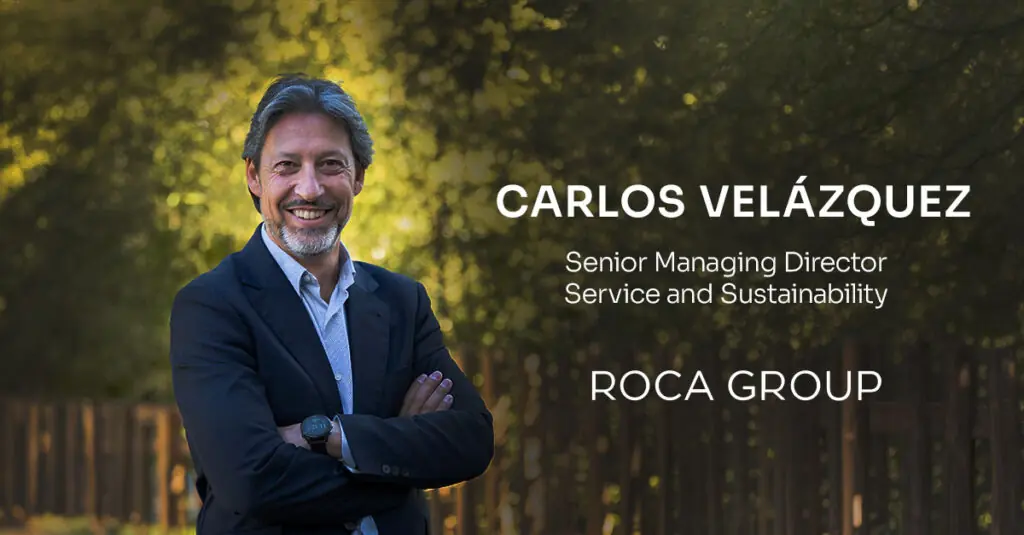
Carlos Velázquez, Senior Managing Director of Service and Sustainability of Roca Group, tell us how necessary is to move toward greater international harmonization and simplify the different regulatory frameworks, so that companies—especially those operating across multiple jurisdictions—can comply without duplication or unnecessary administrative burdens.
Roca Group has a fully integrated sustainability management model aligned with international standards, supported by a global Sustainability Policy, a cross-functional Sustainability Committee, and a double materiality assessment that guides our ESG (environmental, social, and governance) priorities toward generating a positive triple impact on People, Planet, and Prosperity.
As a signatory of the United Nations Global Compact, we work in line with the goals of the Sustainable Development Goals (SDGs), and we deploy this strategy through specific roadmaps such as the Decarbonization Plan with SBTi-validated targets, the Circularity Roadmap, and the Water Neutrality Roadmap—supported by certified management systems (ISO 9001, 14001, 45001, and 50001) and by a robust Code of Ethics and Corporate Standards that ensure integrity throughout the value chain.
Our performance is assessed through internal and external audits, publicly disclosed through our independently verified sustainability report, and was recognized in 2025 with the EcoVadis Platinum Medal, placing us in the top 1% of more than 150,000 companies assessed worldwide under this prestigious standard.
“Roca Group was recognized in 2025 with the EcoVadis Platinum Medal, placing us in the top 1% of more than 150,000 companies assessed worldwide under this prestigious standard.”
In our group, sustainability is fully integrated into corporate management at all levels. The Sustainability Department defines and consolidates the group’s global strategy in this field, sets the lines of work, and drives the specific projects to be carried out. Effective implementation is led by— and depends on—the leadership, commitment, and direct involvement of hundreds of professionals and collaborators across the group worldwide.
Our Sustainability Committee—a multi-departmental and multidisciplinary body made up of the leaders of the areas most relevant to the group’s sustainable development—validates and oversees the implementation of the strategy. The Sustainability Directorate is part of the Executive Committee, ensuring reporting and engagement from both the highest management body and the Board of Directors.
This governance model ensures that sustainability is a central, cross-cutting axis, with impact and visibility at every level of the organization.
Without a doubt, sustainability will remain a key factor for Roca Group—not only because of our long-standing commitment as a century-old family company, but because it is one of the strategic pillars driving our growth, innovation, and business model. Our roadmap promotes the transformation of processes and products to respond to major environmental and social challenges, accelerating the circular economy, eco-design, and efficient resource use, while strengthening our ability to anticipate increasing regulatory and market demands and our resilience to climate change.
“The group already has 8 other plants that produce everything needed to equip a bathroom manufactured with zero emissions: porcelain, faucets, bathtubs, shower trays, and shower enclosures.”
This approach has already translated into significant milestones, such as launching the world’s first electric kiln for the production of sanitary porcelain, which has made our plant in Austria the first emissions-free porcelain factory. In addition, the group already has 8 other plants that produce everything needed to equip a bathroom manufactured with zero emissions: porcelain, faucets, bathtubs, shower trays, and shower enclosures.
These milestones consolidate our position as a global reference in industrial sustainability and reinforce our competitive advantage based on creating sustainable and responsible value— a long-term vision that will continue to guide our future decisions.
Corporate sustainability regulation has advanced significantly in recent years and has been key to driving transparency, comparability, and accountability in companies. Initiatives such as the EU taxonomy, the CSRD, and new harmonized reporting frameworks have helped establish a common language and strengthen the role of sustainability in business management. However, there are still areas for improvement that would accelerate the transition toward more sustainable models.
“A more coherent, simpler, and globally aligned framework would maximize the transformative effect of regulation on the business ecosystem.”
It is necessary to move toward greater international harmonization and simplify the different regulatory frameworks, so that companies—especially those operating across multiple jurisdictions—can comply without duplication or unnecessary administrative burdens.
It would also be desirable for regulation to evolve toward models that, beyond ensuring compliance, effectively encourage long-term value creation by promoting sustainable innovation, circular economy investments, and the measurement of real impact across the entire value chain. A more coherent, simpler, and globally aligned framework would maximize the transformative effect of regulation on the business ecosystem.
I consider it very valuable for a venue to hold a sustainability certification because it not only adds rigor and transparency, but also establishes an objective framework to evaluate and improve its environmental, social, and economic performance. In our case, the B Greenly certification recently obtained by the Roca Barcelona Gallery demonstrates how an international standard helps organize processes, verify good practices, and credibly demonstrate to third parties a real commitment to areas such as energy efficiency, sustainable mobility, responsible waste management, and accessibility—all following an exhaustive audit process that has validated concrete actions.
These types of accreditations not only reinforce a company’s credibility and leadership in sustainability, but also drive continuous improvement and help create culture and awareness among both attendees and internal teams.
We thank Carlos Velázquez, Director of Service and Sustainability and a member of the Executive Committee of Roca Group, for sharing his vision and experience.
Carlos Velázquez, Senior Managing Director of Service and Sustainability of Roca Group, tell us how necessary is to move toward greater international harmonization and simplify the different regulatory frameworks, so that companies—especially those operating across multiple jurisdictions—can comply without duplication or unnecessary administrative burdens.